A novel in serial by Kenn Jordan. Chapter One.
Listen to this chapter. The audiobook proof, read by Sterling. Fourteen minutes, forty five seconds.
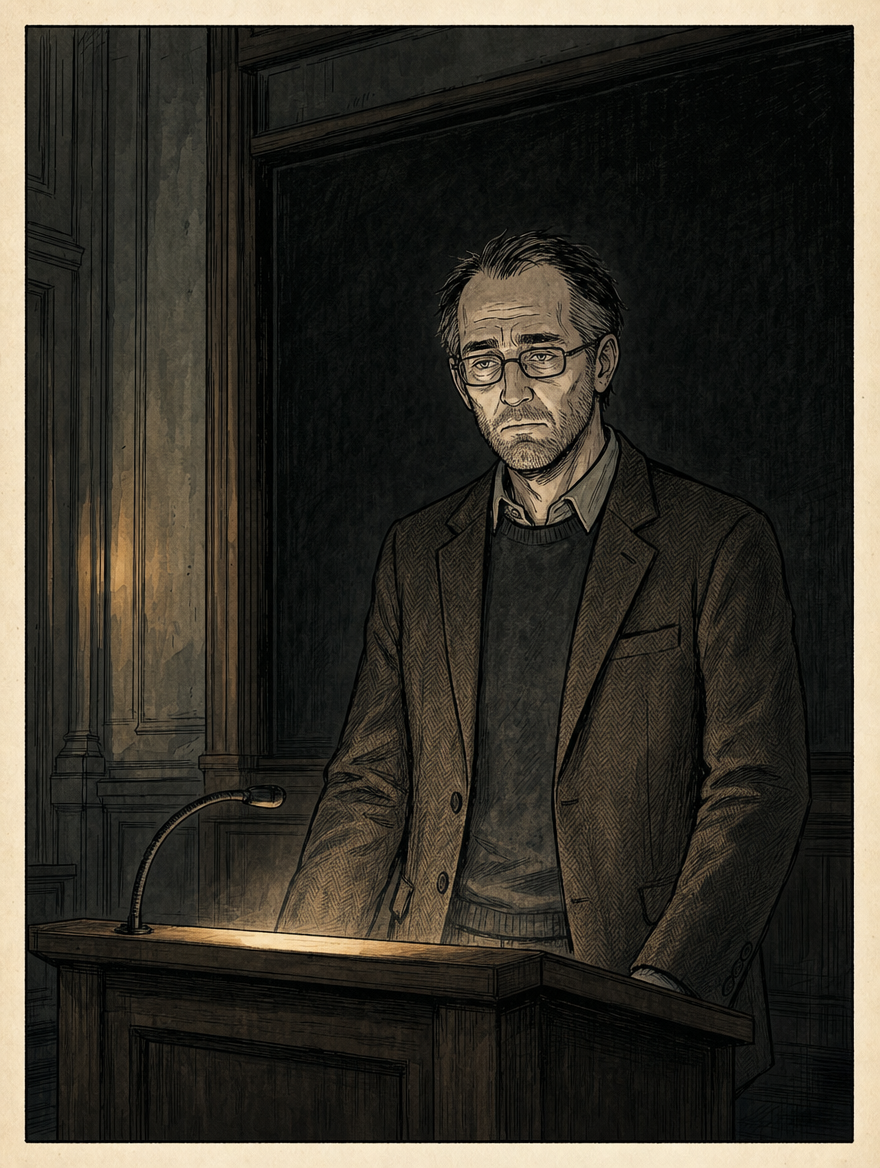
Ninety-four lectures. Panel art from the graphic novel edition, in production.
“…and this,” Alistair said, “is where the universe stops making sense.”
He clicked the remote. The slide changed.
Two slits. A single beam of light. On the screen behind them, a pattern of bright and dark stripes.
“Fire photons one at a time. Each photon leaves the gun alone. Travels alone. Hits the screen alone. Do this for a few thousand photons, and you get this.” He tapped the image. “Stripes. An interference pattern. The shape of a wave that went through both slits at once and overlapped with itself on the way out.”
A hand went up. He ignored it. He had given this lecture ninety-four times. The hand would wait.
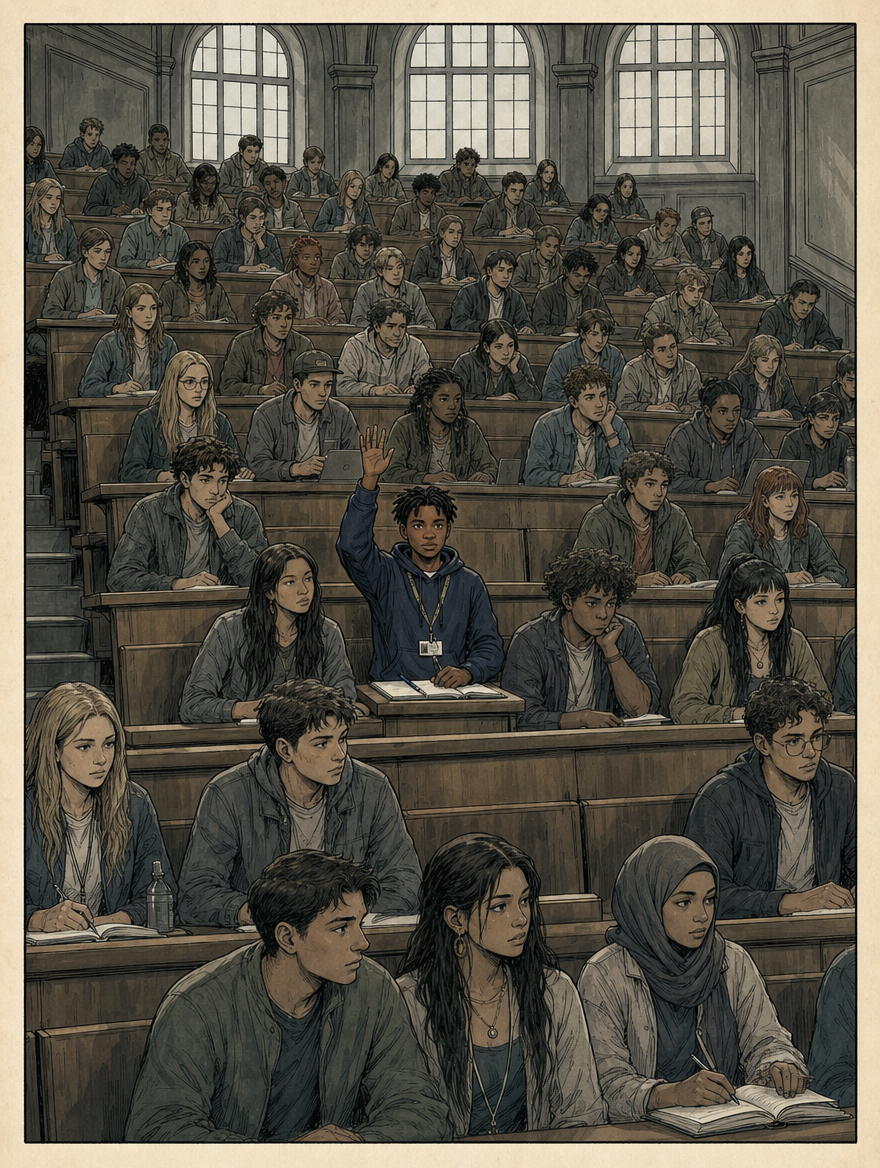
The hand would wait.
“Now put a detector at the slits. Watch them go through. Find out which slit each photon took. And the pattern.” He paused. “Vanishes. You get two sensible bands. As though the photons, the moment you looked, decided to behave.”
He let the silence sit. A hundred and twelve first-year students. The front row were taking notes. The back row were on their phones. The middle did what the middle always did, which was not enough of either.
“This is not a puzzle that was solved in 1930 and then forgotten. It is not a matter of better equipment. It has been reproduced, refined, and stripped to its essentials for a century. Every version returns the same answer. Watch the photon, it behaves. Don’t watch, it doesn’t.”
The hand was still up. He looked at it.
“Yes. Ms…?”
“Okafor.”
“Ms Okafor.”
“So what’s the actual explanation, sir?”
“There isn’t one.”
The room did the small, pleased shiver it always did when he said that. He was supposed to follow it with the Feynman line. He followed it with the Feynman line.
“Feynman said that nobody understands quantum mechanics. He meant it. If you think you understand it, you don’t. The mathematics is perfect. The experiments agree to a precision that shames every other theory we have. What it all means is a different question, and the honest answer is that no one knows.”
He clicked again. The slide went dark.
“Which is why,” he said, “your problem sheet this week is not a meaning problem. It is a calculation problem. Because calculation is what we have. See you Thursday.”
The room broke apart in the usual way. Bags zipped. A few stragglers came down the steps with questions he could have answered in his sleep, and did.
It was three minutes past four. Outside the windows the sky was already going, the light flattening into that Edinburgh grey that meant the day had given up.
He packed the laptop. Unplugged the remote. Walked the corridor to his office without speaking to anyone. The department on a Tuesday afternoon sounded like a printer that had been running too long.
His office was at the end of the corridor. Small. North-facing. A window that looked at a wall. On the desk, among the papers, the box.
He sat down. Looked at it.
The box was small, cardboard, about the size of two bricks. The lid said SIMON in black marker, in his own handwriting, from three years and four months ago. He had written it on the evening of the day he finally accepted the police were not going to find anything. He had put into the box the things he could not leave in the flat any longer and also could not throw away.
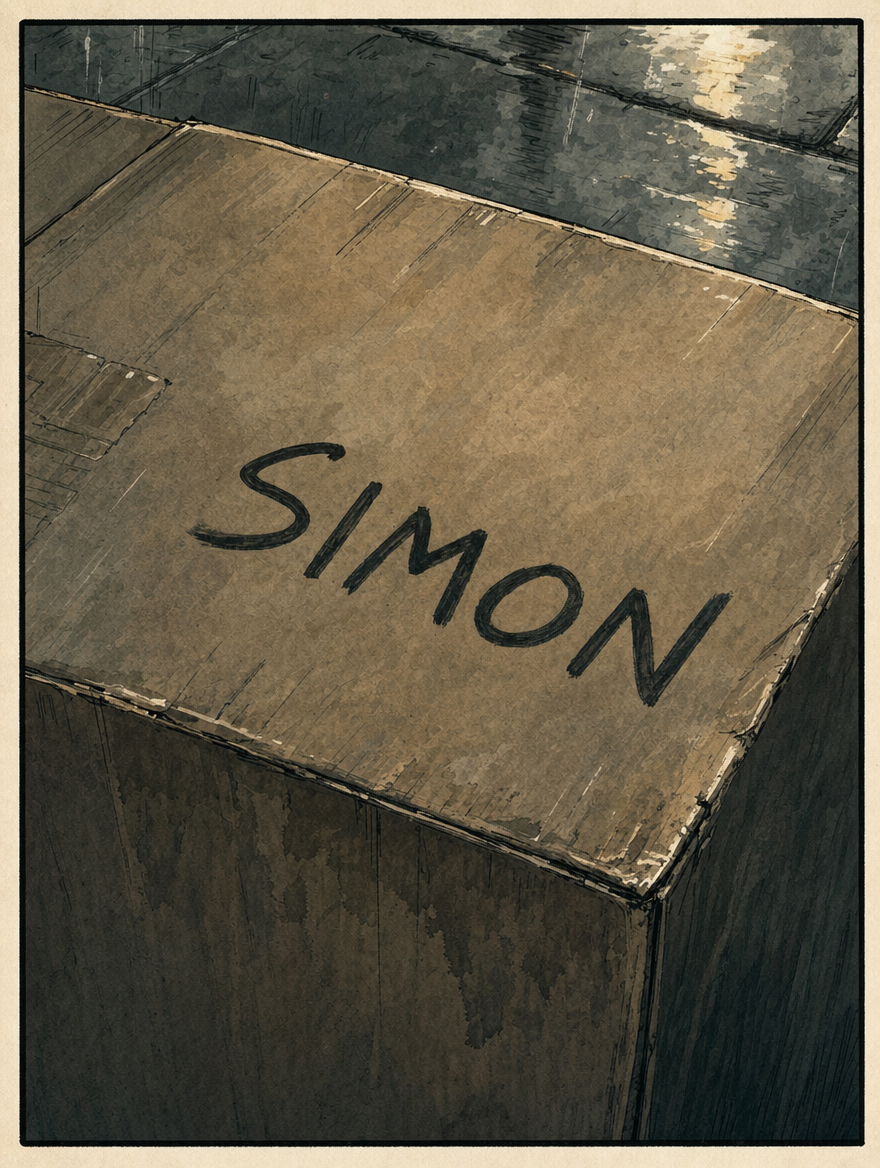
Three years and four months of handling.
A watch. Two photographs. A paperback of The Left Hand of Darkness. A cycling glove, left hand only, the right one never found. An envelope with Simon’s handwriting on the front that said, ALISTAIR, OPEN IF.
He had not opened it.
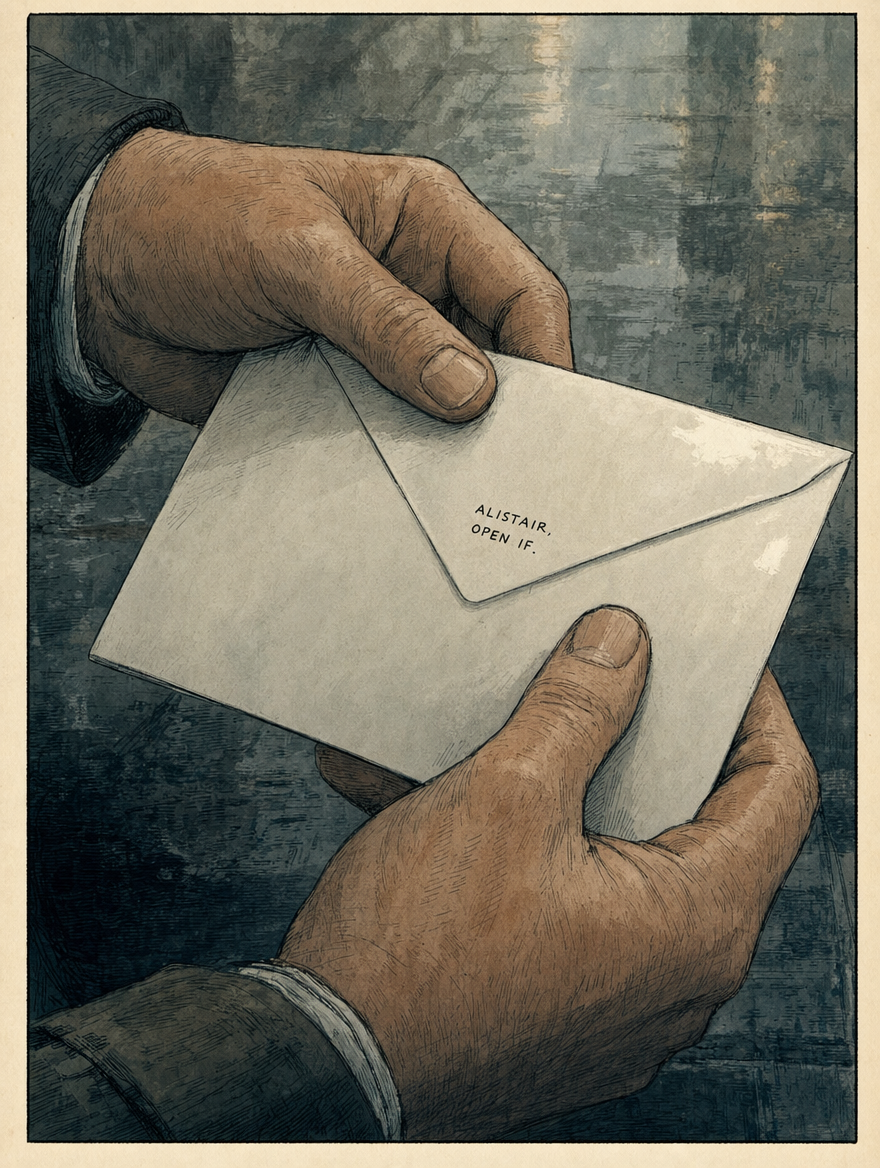
Open if what.
He lifted the lid. Closed it. Lifted it again. This was not new. He did this perhaps twice a week, in the bad months more, and the point was not the contents. The point was the reassurance that the contents were there. That there had been a brother. That the brother had owned a watch and read science fiction and ridden a bicycle on the afternoon he disappeared from a coastal path in Fife with no body, no blood, no witness, and no explanation that any officer of Police Scotland had ever been able to offer.
The watch was there. The photographs were there. The book. The glove. The envelope.
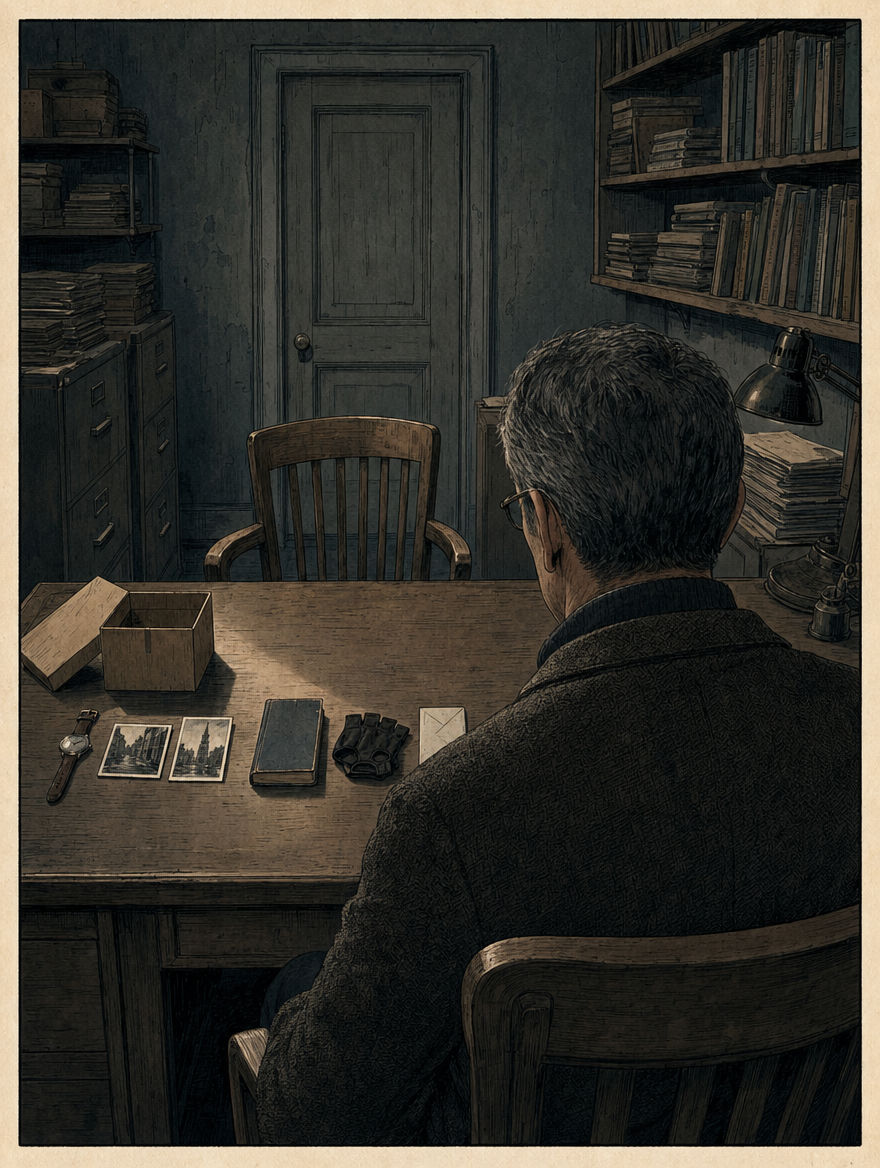
The contents were there.
He closed the lid.
He had not cried about Simon in over a year. He considered this a failure rather than a recovery.
He was forty-three. He had been, once, the sort of young physicist who was spoken of in corridors. He had written a paper at twenty-eight that was cited, briefly, everywhere. He had been on a trajectory. Then Simon had gone missing, and the trajectory had flattened, and then it had curved, and now he was a senior lecturer with a stalled book and a research group of two PhD students, one of whom was leaving.
Ninety-four lectures. He had counted. He counted most things, now.
His phone buzzed.
Helena. His ex-wife, although that word was both accurate and insufficient. They had divorced a year after Simon went. Not because of Simon. Or not only. He had never worked out whether he believed the distinction.
Are you coming on Sunday. Mum wants to know.
He wrote back, Yes.
Three dots. Then, Good.
He put the phone down.
It was twenty past four. He had a supervision at five. He opened his laptop to reread the chapter the student had sent him, and did not read it, and instead opened the drawer of the desk and took out the other thing he kept about Simon, which was a notebook.
The notebook had been Simon’s. Simon had been a maths teacher, not a physicist, but the two brothers had talked about physics the way brothers talk about anything, which is to say with more heat than accuracy. The notebook was full of Simon’s handwriting, in pencil, in the small neat print he used for working. Most of it was lesson plans. A few pages in the middle were something else.
Simon had been working through the double-slit experiment. Not the maths. The interpretation. What it meant. He had filled six pages with questions and diagrams, and on the last of those pages, he had written a single line and underlined it twice.
What if the universe only works out the answer when it has to?
Alistair had read this line several hundred times.
He had, during the worst week after Simon went, come close to believing that Simon had worked something out. That the coastal path had not taken him, that he had instead stepped through some seam in the world that Alistair had spent his career pretending did not exist. It was the kind of thought that arrived at four in the morning and left by breakfast, and Alistair was enough of a physicist to know it for what it was, which was grief wearing the clothes of a theory.
Still. He kept the notebook.
He closed the drawer. It was twenty-six minutes past four. He opened the student’s chapter and began to read it properly.
At four forty-one, there was a knock on the door.
“Come in.”
The student who came in was not the student he was expecting. Ms Okafor. The hand-up from the lecture. She had the apologetic posture of a first-year who had worked out where his office was and was now, having arrived, reconsidering.
“Sorry, sir. I know you don’t have office hours till Thursday. I just. The thing you said about watching.”
“Yes.”
“You said when you watch the photon it behaves. I wanted to ask. Is it the watching. Or is it the measuring. Is there a difference.”
He looked at her properly for the first time. She was perhaps eighteen. African name, Scottish accent, the navy hoodie of a specific Edinburgh state school he recognised.
“Sit down,” he said.
She sat.
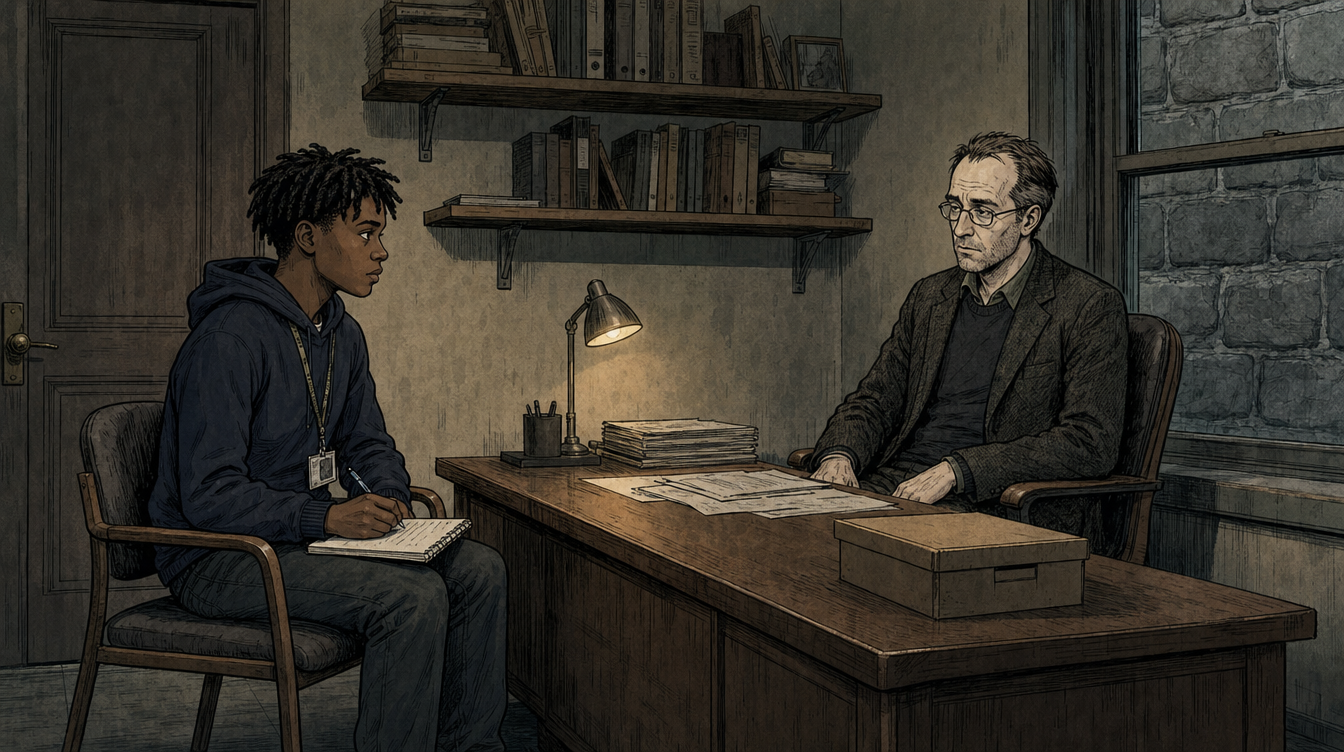
Sit down, he said.
“The honest answer,” he said, “is that physicists have been arguing about that distinction for a hundred years and the arguing has not stopped. Some people say the two are the same. Some people say only measurement counts, and watching is just one kind of measurement. Some people say consciousness is what does it, which most of us think is nonsense but a few serious people do not. Some people say nothing does it, and the behaviour is only in our description, not in the photon.”
“What do you think.”
“I think,” he said, and stopped.
He had been about to say the thing he always said, which was that he thought the question was malformed and the useful move was to stop asking. He did not say that. He said something else.
“I think Simon was probably right. That the universe only works out the answer when it has to.”
She nodded, slowly, and wrote it down.
“Who’s Simon?”
He heard the question. He heard it clearly. He watched her pen, which was a cheap biro, move across the page of her notebook in the small neat script of a student who had been taught to take notes before she had been taught what to take them about. He saw her write, the universe only works out the answer when it has to. He saw her look up. He saw her wait, pleasantly, for him to answer.
“Simon,” he said. “My brother.”
“Oh,” she said. “Is he a physicist too?”
He opened his mouth.
The sound of the department at ten to five came through the door. A printer somewhere. The distant bark of a laugh. A woman’s voice saying something he could not make out, then saying it again because whoever she was speaking to had not heard her the first time.
“He was a maths teacher,” he said.
“Was?”
“He went missing. Three years ago.”
“I’m sorry, sir. I didn’t know.”
“No,” he said. “Of course.”
She asked two more questions about the double-slit experiment and he answered them, he thought competently, though afterwards he would not be able to remember what he had said. She thanked him. She left. He closed the door behind her.
He stood with his hand on the door handle.
There was no reason, he told himself, for a first-year student to know about his brother. There was no reason for the absence of knowledge to feel like anything.
He went back to the desk. Opened the laptop. Opened his email. Typed into the search field, Simon.
The email returned three results. A former student named Simon Hargreaves. A conference in San Marino. A Simone, with an E, from the university library.
He typed, Simon McPherson.
No results.
He sat with this. The search bar blinked at him.
His brother’s name was Simon McPherson. He had sent Simon at least four emails a week for twenty years. He had sent him the draft of every paper. He had sent him, on the day Simon went missing, a photo of a heron standing in the shallows of the Water of Leith, with the caption, thought of you. He remembered sending it. He remembered that Simon had not replied, and that at the time he had assumed Simon was on the train, and that by the evening he had understood that Simon was not on any train.
He typed, heron.
Three results. None of them the photo.
He opened the photos app on his phone. Typed Simon into the search. The app returned photos of a holiday in Cyprus in 2019, which it had tagged with the wrong name, and nothing else.
He scrolled to 2021. The year Simon went. The album he had made, called SIMON, which contained four hundred and sixteen photographs.
The album was there. It had the right name. It contained two hundred and eighty-three photographs. He swiped through the first twenty. They were photographs of empty rooms. An empty sofa. A pub table with two pints on it and no one behind either. A hill path with a bicycle laid on its side on the verge, and no one near the bicycle.
He put the phone face-down on the desk.
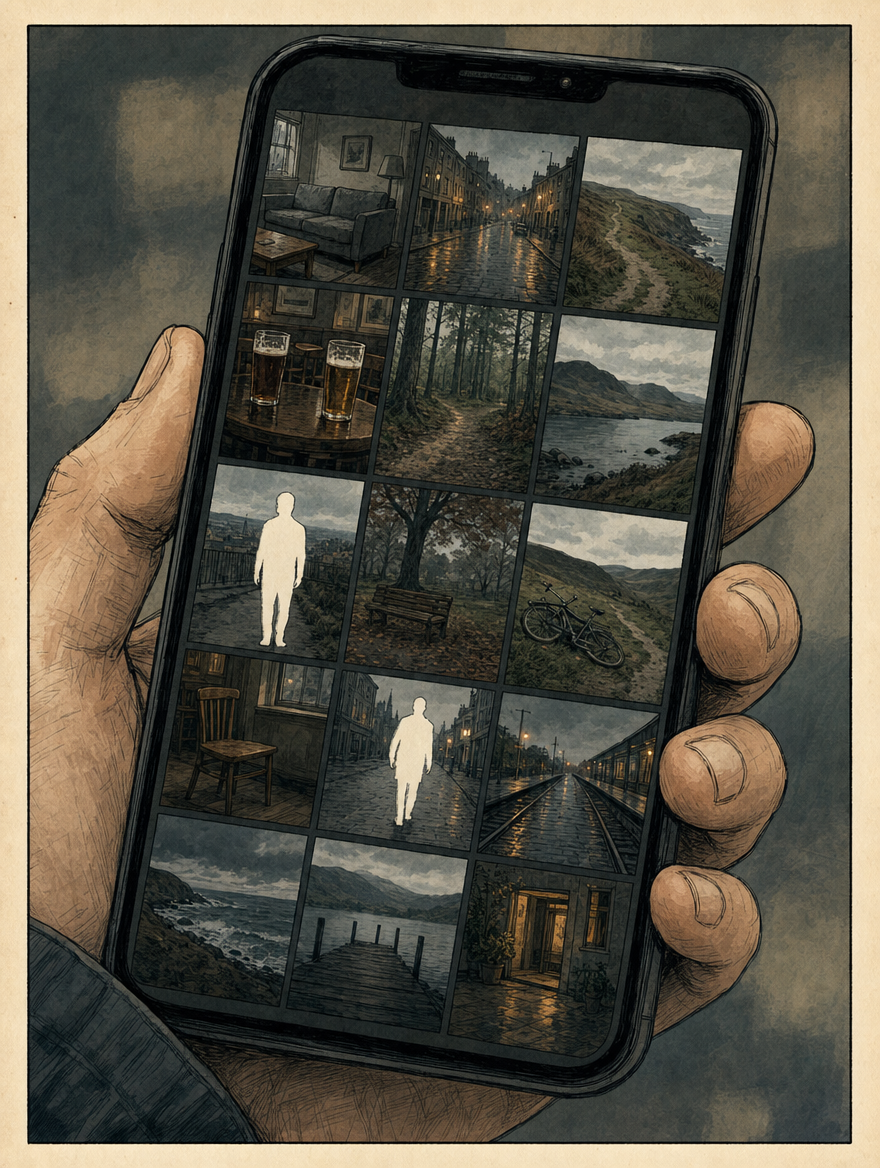
Two hundred and eighty-three photographs.
He opened the drawer. Took out the notebook. Opened it to the page with the underlined line.
What if the universe only works out the answer when it has to?
The line was there.
Above the line, in Simon’s handwriting, where Alistair had read a hundred times the working that led up to it, there was nothing. The page was blank. Six pages blank. The line sat alone on the sixth page, underlined twice, as though someone had taken away everything that supported it and left only the conclusion.
He sat for a long time.
At six minutes past five his supervision student knocked. He did not answer. After a while the knocking stopped.
At twenty past five he picked up the phone and, without thinking about it, called his mother.
“Darling.”
“Mum.”
“Sunday still?”
“Sunday still. Mum. Can I ask you something.”
“Of course.”
“Where’s Simon.”
There was a pause on the line. Not a long one. The pause of a woman who had not expected the question and was trying to decide whether it was a joke.
“Alistair.”
“Where is he, Mum.”
“Darling, I don’t. I don’t know a Simon.”
He said nothing.
“Alistair? Whose Simon?”
He said, after a while, “Never mind. I’ll see you Sunday.”
“All right, darling. Are you all right?”
“I’m fine.”
He ended the call.
Outside his office window, against the wall, the light had gone entirely. He could see his own face reflected in the glass. A man in his mid-forties, pale, with a week of not-quite-shaving and the expression of someone who had just, in a lecture, given away an answer he had spent three years refusing to give.
He thought, very clearly:
I said his name. In the lecture. I told them what Simon thought. And the moment I said it, it started.
He reached for the notebook. Opened it again.
The page was blank.
The line was gone.
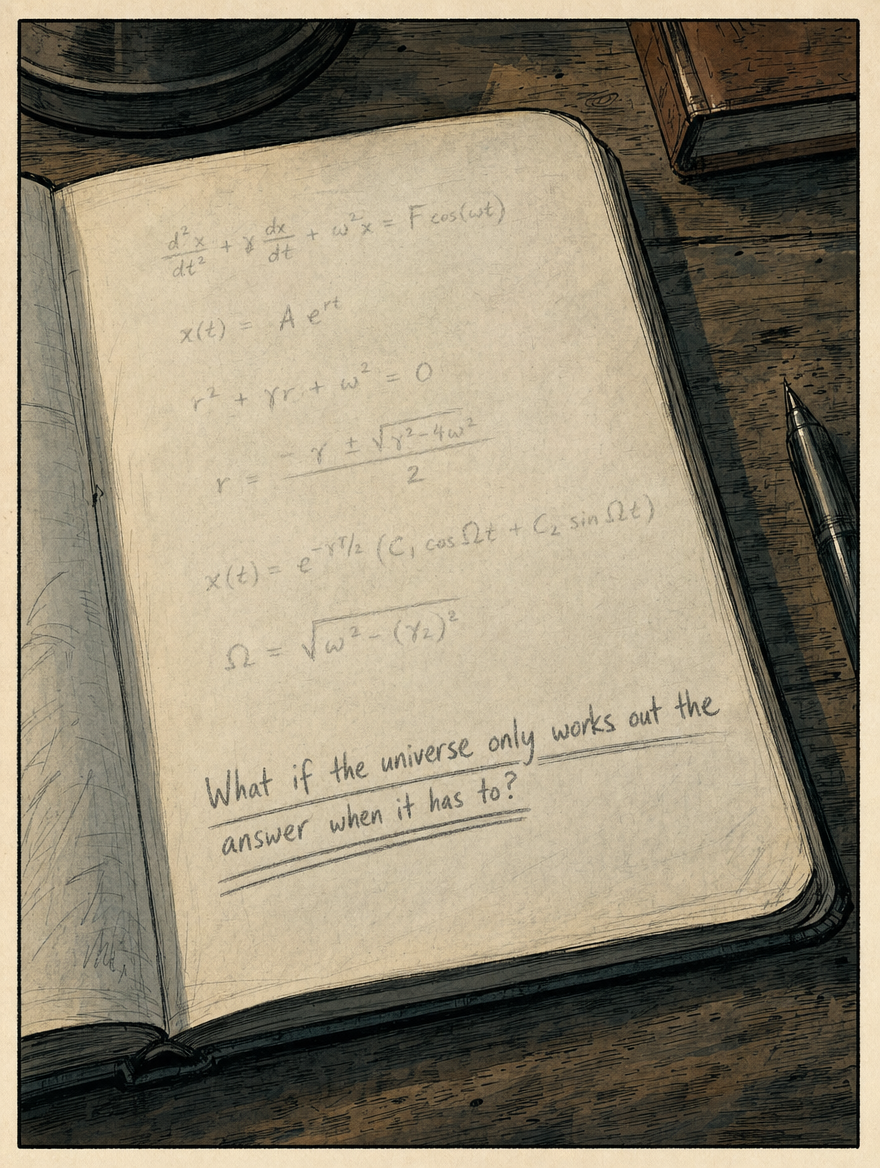
The line sat alone on the sixth page. From the graphic novel edition.
The Ledger continues with Chapter Two: Inventory. New chapters are announced on this site first.
Be told when a chapter lands
Not ready for the pass? Join the list instead and you hear the day a new chapter publishes, and at no other time.
Copyright Kenn Jordan. All rights reserved. Reproduction without permission is not permitted.